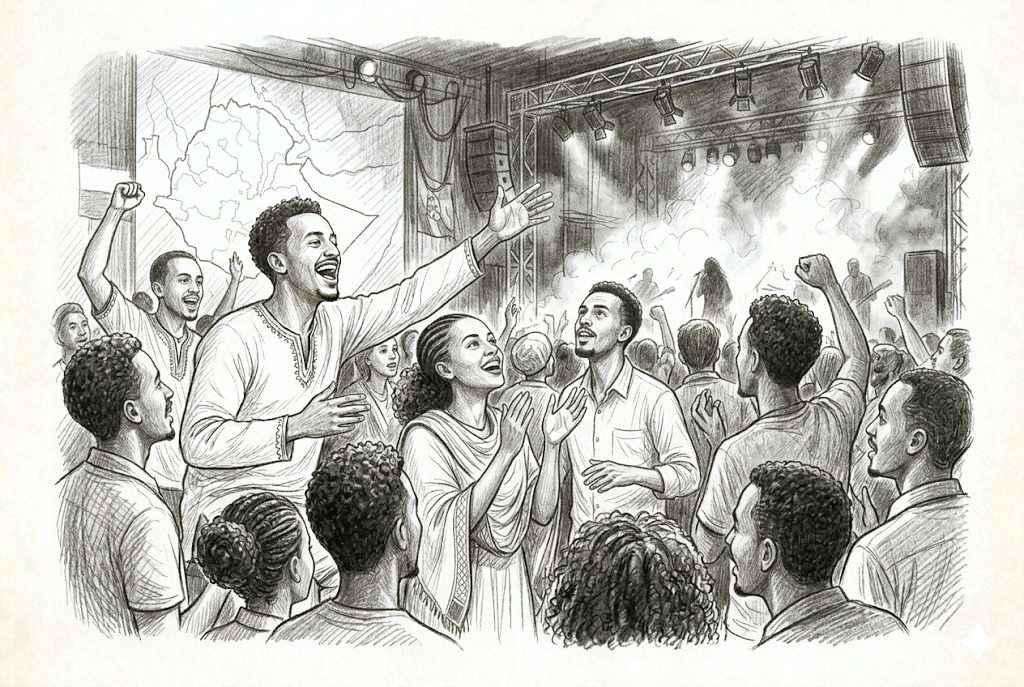
The kids are shouting for the song again. Zerubabel’s “Mindnew Zimitaw,” the beautiful melody — they want it replayed, calling out “Bis! Bis!” — again, again.
Youth really is a fine thing. Life is right there in your hands. Even a song makes you cry “again.” But wait — when you’ve grown up and reached my age, it won’t be a song you’re replaying. You’ll start asking yourself, “Should life be repeated, or not?” Or you’ll say, “I’ve had enough of this one — let me see the next one instead.” Or maybe you’ll find yourself humming through your years, wondering: what if this very life came round again?
…to love again, again
to love, love, again…
Yes — because death is coming, after all.
When Mahmoud Ahmed sings “to love, love again,” the word he’s leaning on is the one underneath: you won’t find it again. Life, bitter or sweet, only passes once. As Mahmoud sang it — “why are you sulking, give me a smile” — life isn’t for sulking. Living pulls at you right down to the last drop. Because there’s an ending. Because something carries you off and keeps you. And so it’s only natural to wish for life a second time.
If even death keeps coming back…
why not be born, again and again…
— so goes Tilahun Gessesse’s song.
On the day someone else’s passing breaks you with grief, and dread comes picking at you about your own end, you’ll turn things over about yourself. If you can’t sing it out, you’ll reach for what you’ve read. Maybe Friedrich Nietzsche’s idea comes back to you.
“The eternal recurrence of the same.” The thought first struck Nietzsche in August of 1881, on a walk through the Swiss Alps — he stopped by a great rock that rose up like a pyramid, and there it came to him. He scribbled it on a slip of paper. He worked the idea out especially through Zarathustra, and before that in a book called The Gay Science — the writing where he asks you to hold your life up, look at it, and decide what it’s worth.
His question goes something like this: “If you were told to live the life you’ve already lived all over again — every last detail, nothing left out — would you take it?” Pay attention: he means everything repeats, exactly as it was.
If you were around in the Emperor’s time, the Emperor falls from power again. The people the Derg executed are executed again. The TPLF marches into Addis again and calls it Ginbot 20. Prime Minister Abiy comes to power again. Trump gets elected again. Everything that happened in your lifetime happens again, the same way.
Everything in your own life happens again too. Your parents have you. You nurse, you grow, you go to school and come home, you finish your studies, you take that same job at that same office, you take up every one of your old girlfriends again. You marry. The children you had repeat themselves. And anyone you lost lives beside you again — and dies on you again.
The roughhousing games of your childhood; the dances of your teenage years; love pressed close, the holding, the mouth-to-mouth with its warm breath; that wrestling-match of love when one bed wasn’t enough to hold it; your wedding day — “how radiant you are now, my darling, my bride,” and the groom puffed up with pride when they called out “hey, handsome!”; the moments you watched your children with your heart full and your insides melting; the day Haile Gebrselassie won the Olympics; the day you found again the friend you’d missed for years — all these and every other moment of joy come back.
Every speck of life repeats. February 17, 1986, a Tuesday, twenty-five past ten in the morning — even the gas you let slip the moment you sat down in the toilet repeats. The lie you told doesn’t go away. The person who deceived you deceives you again. The one who beat you knocks you down again. The illness that took you takes you again.
Even regret and bitterness repeat. If only it had been like this. If only I’d done that. If only I hadn’t done this. If only I hadn’t married this one, him, her. If only I hadn’t been born in this country, to this family. If only I hadn’t been brought into this time — all those useless regrets repeat. And the wishing too: to be young again, right now — if only I’d known then what I know now, I’d have done it differently — every one of those regrets and longings comes back as a wish, repeated. Everyone you met along the way, everyone you let slip, everyone you got close to, everyone you ran from — you repeat them all. Do you agree to this?
Bis, bis — again, again!
But notice: when you wish to be created anew, it’s under a binding contract. There’s not a single moment you get to change — not even one tiny instant you get to say, “let me just fix this part.” Even if you wanted to, you couldn’t. Because you won’t know it’s the repeat. You go into it knowing all of this. Without ever saying “enough, I’m tired of it,” you’ll live this, repeating it, forever. Which is to say: you’ll live this for eternity, dying and rising and doing it all again. This life of yours becomes the one you live over and over, forever, without changing a thing. Do you agree to this?
If someone asked you, “what do you want to become after you die?” — would you say, “leave me right here, it’s fine”? Or have you already bought your ticket to the house upstairs? Or are you the one who, as Nietzsche tempts you to, says: again, and again, and over and over — dying and being reborn, repeating the same life, being repeated — round and round, without stop, forever, count me in?
The good thing is, Nietzsche didn’t bring up the idea to talk about the life behind you. He meant the life you have now and from here on. He wants to remind you: the life you live today is the one you’ll want to repeat tomorrow.
There’s even a name for it — amor fati, “love of your fate.” It means loving your life so completely that you’d gladly take it all again, exactly as it came.
So, my friend: in whatever life you have left, you should live each day sure that you’d want to repeat it tomorrow. Not just tomorrow, even — you should live as if to say, “I’ll live this over and over.” Play around with Nietzsche’s idea now and then.
Who knows — if you’re told to repeat it, you might not regret a thing.
By the way — don’t ask me where it comes from, but “bis” means “again, do it once more.” And the Habesha way, as you know, is that the same word turns around a little later and means something else entirely. Take “waga-bis,” “erbana-bis,” “qelbe-bis” — there, “bis” comes to mean empty, void, worthless, good-for-nothing, and the like.
So when you call your life “bis, bis,” say clearly which one you mean: bis — let it repeat, it’s worth it — or bis — it’s worthless. What I mean is: live knowing the difference. You, and you too — each and every one of you.
This article was originally published in Amharic in Ledesta.
Subscribe to Ledesta
New writing in your inbox. English and Amharic.