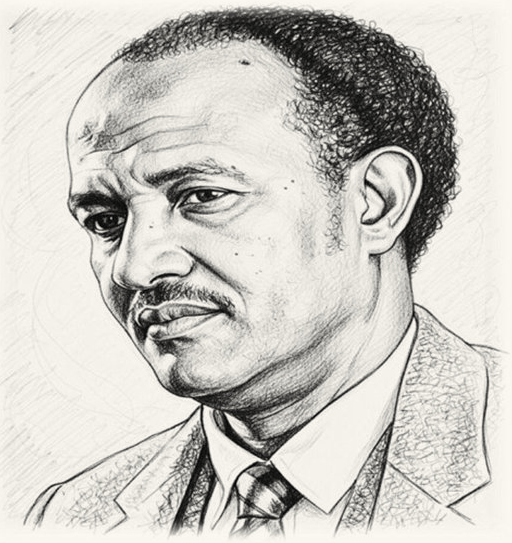
“…qelqelo silcha, silcha qelqelo silcha silcha, qelqelo qelqelo…”
Silcha in Amharic, qelqelo in Afaan Oromo. Both are the same thing. So what separates them? Nothing.
It was Mengistu Lemma who left us this saying — one that can serve as a refrain for all sorts of situations.
About the renowned man of letters Mengistu Lemma, much has been said of his life: born here, raised there, came into his own over yonder, and so on. We won’t repeat all that today. For three reasons: first, so as not to be silcha qelqelo about it — the same thing twice; second, because anyone, after all, is born, grows up, and dies; and third, because a life story, unless it’s tied to the work the man is known for, what good is it? So, to avoid all that, here is how we’ll go about it.
Gash Mengistu had a wife. Her name was W/ro Yeshi W/Kirkos. About Gash Mengistu, she “said this” — as recorded for her by Wendsen Beyene:
I grew up in the middle of a big family. A house full of children. Full of noise. But Mengistu’s house was hushed, dead quiet. A silence that gnawed at the belly — anguish swallowed me. On top of that, the lunch I’d set out, some days I ate alone. Or it came back again for dinner. There were many times the coffee poured for him sat forgotten until it went cold. The meal would be served and he’d read a book. I’d speak to him and get no answer. And on top of that, all night long he’d go into the little reading shelter he’d built on the veranda and write, and read. And once he got hold of an idea, he wouldn’t let it go. He’d return to the same thing again and again in his anger. With all of this piling up on me, I couldn’t get used to it. Even before, when things weighed on me, I’d go and spend the day at my family’s and come back. Then I started staying over. Then we’d reconcile and I’d come home, and so it went, out and in. We pushed on together a little while. Even after we had children, it went on the same way. In the end I took my two children and moved in with my family. He didn’t say come back, and I didn’t want to. We separated — before our marriage contract had even run its eighty years. And then it became a solitary life. By the road that drove us apart.
So — Mengistu, of whom this was said — what might he have said? After all, some write what they’ve lived. And there’s no shortage of those who live what they write. In any case, here’s what Gash Menge wrote:
Goodbye, fare well;
The fault isn’t yours, nor is it mine;
That love is what it is — its blessing and its curse;
That you are you, and I am I.
If we hold this poem up against his wife’s account, it seems to ring true. But Gash Menge didn’t seem to like it when people tied his private life to his work. In Yegitm Gubae (The Poetry Assembly) he said this:
There’s just one thing I’d like to remind you of — with your kind permission. If someone comes and tells you, “When the author wrote this book, he was writing his own private story,” then before you agree with that idea, I’d ask you to remember Shakespeare and Bernard Shaw. Both of them wrote, in dramatic form, stories they never saw and never lived through.
Even if we don’t say, as he feared, “he was writing his own private story,” it’s not good to keep them forever apart, either. To do so would lessen, for us, the value of knowing the lives of literary people. For instance, if we ask, “Mengistu Lemma — how did he become such a renowned poet?” we’re compelled to look at his upbringing and his way of living.
In his childhood he learned Ge’ez. He gleaned the qiné — the sacred poetry. He spent his days and nights among the church scholars. Why, more than that — he was born into it. So why wouldn’t a fine poet come out of him? Especially with modern schooling added on top.
And — well, fine, grant him that. But then, where did he get this modern style of versifying? Especially the love poetry — if we ask about that, he answers us himself, tying it to his own life:
What set me off writing modern love poems, especially, I think was the Platonic love stirred in me in childhood — playing “husband and wife” with a relative’s child named Zinash.
Of course, given Mengistu’s ways, Zinash didn’t stay with him long. When Zinash left, the poetry didn’t leave; it went on. What made it go on? This was the poem with which Gash Menge said “In the name of the Father” and stepped into the world of letters — the one he named “Put It to Work”:
Beggar: Please, sir, give me some alms — I’m in great trouble, utterly poor.
Master: From what’s in my pocket — this hundred-birr note — wait a quarter hour till I get it changed.
Beggar: Pardon me, sir, if I may be so bold — tell me now, how much will you give me?
Master: What I’ll give you is one birr; if I can’t get change, what’s to be done?
Beggar: Ninety-nine birr I have in my pouch — let me fetch it, quick; wait right here, please… Here I am, back — at your service, sir. Give me the note, and let me give your change.
Master: My wealth, over your poverty — it comes out ahead by just one birr. Here, let me give you some advice: put it to work.
After that, Menge could say this:
…The students read it as if it were a marvel. Everyone loved my poem. Word of it spread through the school. And I felt a hidden pride, veiled in humility — the pride of a church scholar, a priest. From then on, all I could ever see myself doing was writing poems.
It may well be that this same poem first made him try his hand at the world of the stage, too, not just verse:
While I was studying at Kotebe, I presented this poem of mine again, for the first time, in the form of a play.
He did this as a boy, while still in school. What made him outstrip all those other children — to ripen early and produce work like this?
It was in his father’s house that he began to count his letters. And when we say father, this was no ordinary father. He was a teacher of the Hadis at Addis Ababa’s Menbere Tsebaot Holy Trinity Cathedral. In other churches too, teaching the interpretation of the Hadis and the Faith of the Fathers, he’s said to have raised many disciples. He administered many churches as their head. Menge, then, is this man’s son.
That’s not all. Menge would sometimes slip off and drop in on the Italians. With a boy’s strength, he likely tried his hand at a bit of work, too. There among the Italians, he ran errands house to house. He washed clothes. Through this, he came to know the Italians’ kitchens. This experience of his came not out of thin air but straight from his writing. In Tsere-Colonialist (Anti-Colonialist):
Gebreyes: It’s laundry that’s to be washed. On my way here earlier I stopped at Signor Armaleo’s house. A pile of dirty clothes had built up, and he loaded me with this. He said if it’s not washed and pressed and ready by tomorrow, you’ll get a beating.
Wihib: I’ve told you once, brother. I can’t stand Armaleo’s foot-socks — the stink of them. The day I wash that man’s clothes, food won’t go down my throat.
Because his father found out he’d taken work with the Italians, Mengistu was given the rank of deacon and returned to church service. Reckoned at twenty lire a month, he was the one who rang that church bell. It was only after this that Menge came to the modern school.
Gash Mengistu finished his local studies, writing poems every Sunday. In 1940 he crossed the sea and entered a school in London. And since it’s “when you go far…,” he plunged into yet another kind of experience. And so?
First he read his surroundings, with both eye and palm. He measured them against his own country. And it began to gnaw at him. In his very first year there, he started scheming with others of his kind to found an Ethiopian Students’ Association in London. The association was founded. A little later, he took the presidency for himself. And then?
Then he gave himself a pen name: “Ethiopis.” Since he was also editor of his association’s “Lion Club” newspaper, it suited him. He set the writing going. Moving beyond his own paper, he began holding forth on Ethiopia in the weekly London press. On top of that, he’d started reading his Marx and his Lenin. And the renowned literary works of the world, likewise.
Now Menge, baptized in the holy water of the writers, cutting himself off from people, following his own road, began a kind of rebellion. He sank into the political game that the government of the day neither wanted nor relished. He held forth in every paper and every association. He crossed the lines of lineage and fell in love with the daughter of nobility. And when told, especially, to “let go” of this love of his, he said he wouldn’t give her up — not for one of his own people, and not for the liṭa liṭos (the whites) either. And he began to argue that love knows nothing of such things. Was it for this that he composed this poem?
…But love draws across bridle and blood;
it was love that joined them, in the foreigner’s land;
so it’s possible after all — to become one body;
there’s no meaning in it, unless we become one likeness.
In particular, if you look at his London stay and his play Bale Kaba na Bale Daba (The Man of the Cloak and the Man of the Rags), the resemblance grows close. Not only does the play open in a London memory — the stubbornness of its character Gezmu resembles Menge’s own. In Wendsen Beyene’s study, Ato Mamo Wudneh is quoted saying this:
Gash Mengistu’s trait that no amount of advice could improve was his arguing — and that even if heaven and earth passed away, he could not change his mind and say “I’ve had enough, you’ve worn me down.” He was stubborn.
It’s said that by this very stubbornness Menge parted from the noblewoman he’d loved. And so it goes with Bibita and Gezmu of The Man of the Cloak and the Man of the Rags, too:
Bibita: My uncle asked me a great deal about you.
Gezmu: About what — about what of mine?
Bibita: What’s this nonsense, dear? They say you have a stubbornness in you.
Gezmu: What stubbornness, my love? What kind of dryness is it? Thin, pale, is that what they call it? Or do they mean my source of income is dried up?
Bibita: Please — I don’t think this is leading us anywhere. All my relatives told me, “We’re ashamed for you, loving him.” Cast off this foolish stubbornness of yours and leave it for them.
Gezmu: And if I left it for them, what would they give me?
Bibita: They’ll give you Bibita — with fifty gasha of country land, ten thousand square meters of city plot, and nine villas.
Gezmu: Don’t tempt me. I can’t give up my stubbornness. It’s grown into me… “Unless you change your thinking,” she said. “Choose,” she said — between her and my way of thinking. I chose my own self. Reckoning it better to be my own self, I gave Bibita her freedom. She gave me back my ring. She left. We parted.
Here, if we look again at the poem “Goodbye, fare well,” it rings true once more. It’s striking how it fits — coming not only from his private life but from the very work he made. And when we think of the long solitary life of both Menge and Gezmu, it’s the same. Even though we don’t see Bibita in Alacha Gabcha (The Mismatched Marriage), even hearing about her makes you say, “How’s that, now?”
Gash Mengistu spent six years in the foreigner’s land, but he didn’t come back holding a degree. On top of that, he was a difficult man. So who would give him work when he returned? While others were handed power, then property on top of position, then a car besides, Menge didn’t even find a job. So Menge — being no schemer — does this:
To disturb the avenue where the so-called scholars strut about idle, it seems, he buys a little jalopy. He cuts off its exhaust pipe. Then he makes it screech and backfire, and rattles it down every street — Addis Ababa, by jalopy! Even the car he bought later was the same. Because its headlights had gone out, he called it “Oedipus.” It’s rebellion, you see.
Mengistu Lemma trod the floors of four offices, but neither his chair nor his pocket grew. It stayed just as it was. He didn’t get on with his bosses. He didn’t agree with his friends. He was solitary. He didn’t even mix with the neighbors. And his pen-child Gezmu is his sort, too. Or is it him?
Techane: Think, now — think. How many times have I told you? If you’d just change your whole belief, your whole way of thinking, you’d have reached some high place by now. How long will you go on living beneath your friends?
Gezmu: What should I become — changed? Who should I be?
Techane: What does this show? It means you have no spirit to grow, to rise. A day’s bread, a year’s clothes, a peaceful sleep — what are these? They’re a grace given even to the animals.
Gezmu: Even so, even so — I rise in the morning from my sleep, wash my face, shave my beard, and in the mirror I see the face of a man I know. What I see doesn’t shame me. Forehead to forehead, eyes full, I can look at my own self.
Gash Menge was just so. He lived in the married world only a short while. After that he was a bachelor, and a bachelor’s bachelor at that. The only face he saw in his house was his own — in the mirror. No one else came near him. Apart from his nearly two thousand books, there was nothing to keep him company. The “silence” his various works are named for likely came from no other source than this way of living. And on top of that, with all his reading added in, he may well have been driven to philosophize about silence:
It’s futile, my friend, to interpret, to expound;
to say “if this, then this; therefore that”;
our answer may as well be silence, lest we wear ourselves out over what we cannot know;
for what is greater than silence, let our own heads bow;
yet silence alone won’t satisfy either —
like a stammer, a word that bears no fruit.
Mengistu, who says “silence itself isn’t enough,” says even in his writing that the author should “do likewise.” In his preface to Alacha Gabcha he wrote: “Leave the preaching, the counsel, the lesson to the priests of God. The author’s work is to write a good composition. Let the book speak. Let him hold his tongue.”
And yet Menge did not stay silent. His mockery, his gibes, were not to be borne. Even by mouth, the day he came at you, you weren’t to be tasted lightly. And in his writing, the same. Especially the jab he’d slip into the preface of each of his works was no trifle. Take this one:
In the weaving of verse, the author has not followed the way of the riddle, nor the gymnastics of the acrobat. Foolish over-refinement and obscurity smother a composition’s message. Wasn’t it said that the harvest of the qiné is “good”?
There’s no need to explain this, of course. The jab is clear. However you turn it, it doesn’t lack the message: “Please — say what you have to say in plain language, don’t over-refine, let what you mean come through.”
In his works, setting generation against generation, the new against the old, he made mankind laugh at itself once more. And as he said, though he held his own tongue, his work spoke. Menge, siding with the old generation, remembering his fathers like Aleqa Lemma, drawn by the church education he’d passed through, comes down hard on the modern generation:
…this generation’s crop — flabby philosophers;
every heart-flatterer, spirit gone slack, will drained away.
And if there’s anyone who reads this poem and asks, “Why, Gash Mengistu — what did we do wrong?” — he explains it through Bezabih in Telfo Bekisew (Snatched into His Pocket). Bezabih, thinking of the older generation:
Now are we your children? Don’t pile up theory, don’t season your talk — you did your work, and when you reached the summit, your spirit didn’t fail you. In your day there was no such split between the man of words and the man of work. A person is a person. That’s all. Your thought and your work were one. When were your hands and feet ever bound by the golden chain they call new civilization, modern education?… No — it’s only in the flesh that we were born of you.
So, then — living thus, Menge wrote thus. By this and traits like it, across his various works, he managed to create characters who all share the same nature. Ato Aboneh Ashagré saw exactly this:
The major characters across Mengistu Lemma’s various plays are linked together as if by a chain. Bezabih of Telfo Bekisew, Bahru of Alacha Gabcha, Ig’letu of Teyaqiw (The Petitioner), Kassa of Tsere-Colonialist, and Gezmu of Bale Kaba na Bale Daba — though they’re given different names, they share a common, single nature.
What chained these characters together? Did Mengistu load it onto them without knowing it? In any case, as we’ve skimmed lightly over Mengistu’s works, they draw close to his private life, his nature, and his beliefs. As he himself said — not, “even what they never lived, like Shakespeare and Bernard Shaw” — but rather, what he saw and what he lived: that is what he wrote.
This article was originally published in Amharic in 1984 (Ethiopian calendar), Addis Ababa.
Subscribe to Ledesta
New writing in your inbox. English and Amharic.