Sebhat, not by choice,
the things he will not say:
he has either lost their meaning,
or found it.
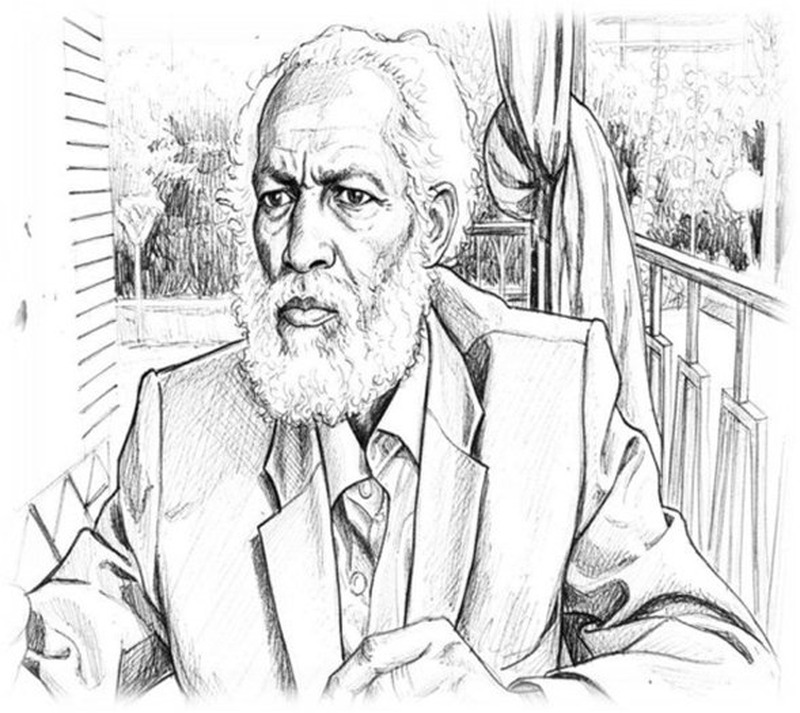
“Gash Sebhat, it’s not by choice, is it?”
“That’s right, my child. Not by choice.”
“Tell me a tale?”
“A tale?”
“Yes, a tale!”
“I can’t tell tales.”
“But you write them, don’t you?”
“Tales?”
“Yes, tales!”
“They aren’t tales.”
“What are they, then?”
“They are life.”
“Can life be written?”
“Not all of it.”
“Why not all of it?”
“Because not all of it can be found, my child.”
“So there is unfinished life?”
“That is why I called it a tale.”
“Called what?”
“That little life.”
“Oh, Gash Sebhat.”
“Oh, my child.”
Sebhat, not by choice,
that he writes the way he does:
it is so that others won’t grow bitter,
even as he himself is bitter.
Sebhat, not by choice,
that he keeps calling out the poor, the poor:
he lifted the curtain of wealth
and saw.
Sebhat, not by choice,
that he says laugh, let us weep:
because they take turns,
becoming day and night.
Sebhat, not by choice,
that he tells tale after tale:
because life and tale
have tangled inside him.
“Gash Sebhat, you’re obscene, aren’t you?”
“A man doesn’t get crude on his own.”
“What I mean is, you write naked things.”
“But that’s the truth.”
“Does that mean all your writing is true?”
“No. There are lies in it too. Sometimes I dress people up.”
Sebhat, not by choice,
that he wrote nakedness:
Adam and Eve
came to his mind.
Sebhat, not by choice,
that he kept saying sex, sex:
he understood it was
the hatchery of wonders.
Sebhat, not by choice,
that he said both truth and lie:
because they refused him,
insisting they would not part.
“Gash Sebhat, what is a human?”
“God’s manuscript.”
“What kind of manuscript?”
“An unfinished one.”
“When was it begun?”
“Fifty years ago.”
“How old are you?”
“Fifty.”
Sebhat, not by choice,
that he speaks now plainly, now subtly:
people and creation
keep forcing him.
Sebhat, not by choice,
that he says let me be plain:
he is tired of suffocation,
searching for air.
Sebhat, not by choice,
that he speaks with animals:
living among them,
their silence is too heavy.
“Gash Sebhat, why did you leave Wubay Berahaa?”
“It became only Berahaa — only desert — for me.”
“And Wubay?”
“She withered.”
“What helped you then?”
“I found a book.”
“You didn’t read in those days?”
“In those days, I only read Wubay.”
“And now?”
“I told you, the book.”
“What does the book say?”
“It says it knows where Wubay went.”
“Did it tell you?”
“It said: not before you write.”
“About what?”
“About Wubay, and the Berahaa.”
“You’re a wonder.”
“Yes, my child. And I am writing that too.”
Wubay Berahaa was a celebrated nightlife quarter of Sebhat’s generation; its name means “beautiful desert.” Sebhat speaks of the place as one might speak of a lost love.
“Gash Sebhat, death has come!”
“I have seen him.”
“Did you die?”
“Almost.”
“How did you survive?”
“I tricked death.”
“How?”
“I sent the Agafari to him.”
“And said what?”
“I said: if you’re a man, face him.”
“And then?”
“They are facing off.”
“By the way, how did the Agafari agree to it?”
“That is what surprised me too.”
Sebhat, not by choice,
that he refused death:
because the Agafari, willing,
said: I am here.
Sebhat, not by choice,
that he locked into argument:
he said: not until I see the end of life.
Sebhat, please:
do not say yes to death
without knowing the end of this.
(1983 EC, Addis Ababa)
Written by Dereje Desta. English narration is AI-generated.
Subscribe to Ledesta
New writing in your inbox. English and Amharic.