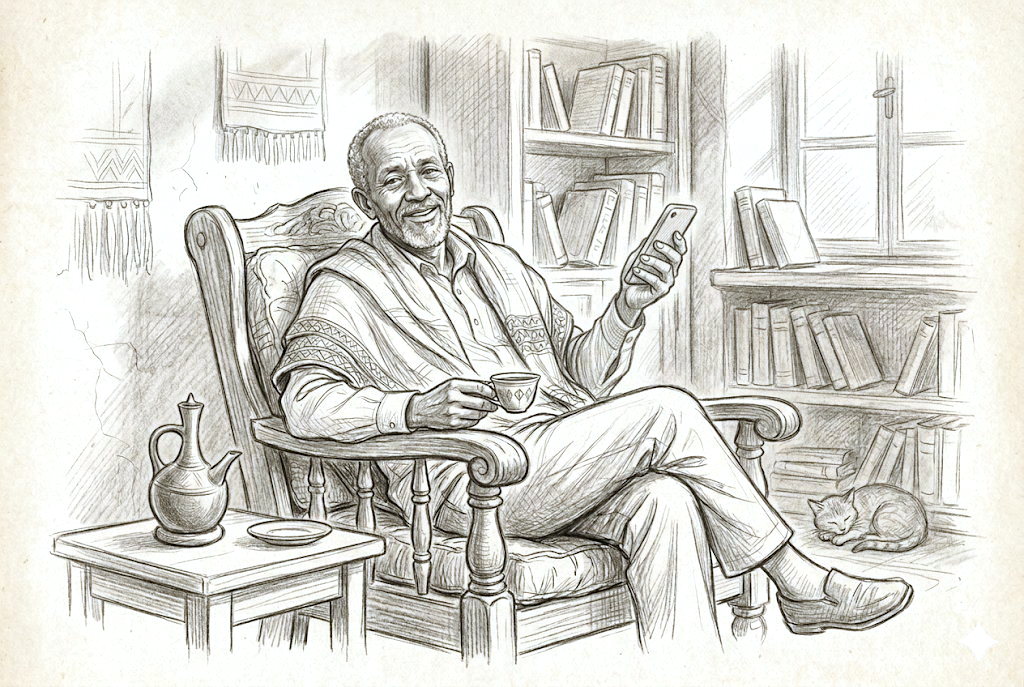
Of all the phrases in our language, perhaps none is more uniquely Ethiopian than “Eye mettahu naw,” meaning I’m coming. Is there any word we use more often? It’s hard to imagine one more Ethiopian.
We say “I’m coming” without moving our feet from where we stand. Who said coming requires motion? We may be on the sofa, the chair, the bed. What prevents us from saying “I’m coming”? Time sorts itself out eventually, and since we’re going anyway, what’s the rush?
At a restaurant, we hear it again and again: our food is coming, it’s almost here. Even when you’re hungry, you wait. There is no grace like waiting. Waiting is hope. The food will come. When the waitress standing beside us says, “It’s right here, on its way,” we don’t ask, “But have you seen it?” We don’t accuse her of lying. She isn’t.
The bride and groom are on their way. They’ll be late, but they won’t fail to arrive. “Want to bet?” someone might say. Because there’s no wedding canceled by tardiness, no meeting that didn’t happen because of the clock.
This is not a lie. It is our cultural hopefulness.
The bride and groom who say “we’re coming” may not even have left the house yet. The point is that they are coming. Of course they are. Have they ever failed to arrive? Never.
And then there are the unwritten rules in our culture, laws inscribed somewhere inside us, invisible but binding:
- Brides and grooms arrive when they feel like it. The wedding begins at the hour they choose.
- Meetings start not at the appointed time but when enough people are believed to have gathered in the hall.
- The jebena coffee is ready not when the stove is hot, but when the conversation has warmed and deepened.
- The Addis Ababa taxi moves only when it is full.
- The government turns on the electricity when the electricity decides to come.
At a Habesha gathering, if a heated political or religious conversation slips into the meal, lunch quietly becomes dinner.
Time in Ethiopia is not the prisoner of events. “Calm down. Slow down. Where exactly are you trying to get to?” These are reminders that for our overflowing, abundant Habesha hours, what could possibly be rushing you?
Even if a Habesha runs, time does not move. What is making him run? And anyway, who has summoned time, that it would even bother to answer?
Today is 2026. In the Habesha calendar, it is 2018. Why is that?
Now someone might say: “In America time runs, in Ethiopia it crawls.” Tell that to some of the Washingtonian Habeshas at the height of the busy workday, when you can’t find a soul on the street, and then walk past the Ethiopian restaurant down the block, packed full of Habeshas watching Manchester play Arsenal. Time is relative, my friend.
In the middle of New York, if you see someone walking slowly from a distance, who would even suspect they might be one of my countrymen?
If it’s Sunday, forget about time entirely. Even time itself rests. Mothers who’ve sat through three hours of sermon for one hour of prayer step out, white netella crisp around their shoulders, walking down the street as slowly as astronauts moving on the moon. Who could be surprised?
What runs the world today is the scarcity of time. The world has been colonized by time. We Ethiopians, the one country never colonized, what would they say to us if we boasted about this one too?
The good thing is, we still have hope. We give one another hope. If we say “we’re coming,” we come. If we say “I will come,” it might not happen, but it is still hope. “I’ll call you.” “Let’s talk soon.” “Let’s not lose touch.” “Please, please, let’s meet.” These are all hopes. Even if they never come true, saying them feels good.
“We shouldn’t only meet when someone dies. We should meet always.” That is the relative and neighbor refrain at every funeral. Yes, we let life slip by without seeing or speaking to one another, and then death arrives first, and so we say: please, let’s meet. This kind of talk shouldn’t be criticized. It’s a good wish. So what if we repeat the same talk at the next funeral, and the next, and the next? It is something we all truly want. It’s just that it doesn’t quite happen. What is it that doesn’t happen? Is it time? Or is it that we are not filling our time with what we need?
Anyway: let us not lose each other. Seeing each other is right around the corner. We’ll meet soon!
This article was originally published in Ledesta Amharic by the author.
Subscribe to Ledesta
New writing in your inbox. English and Amharic.